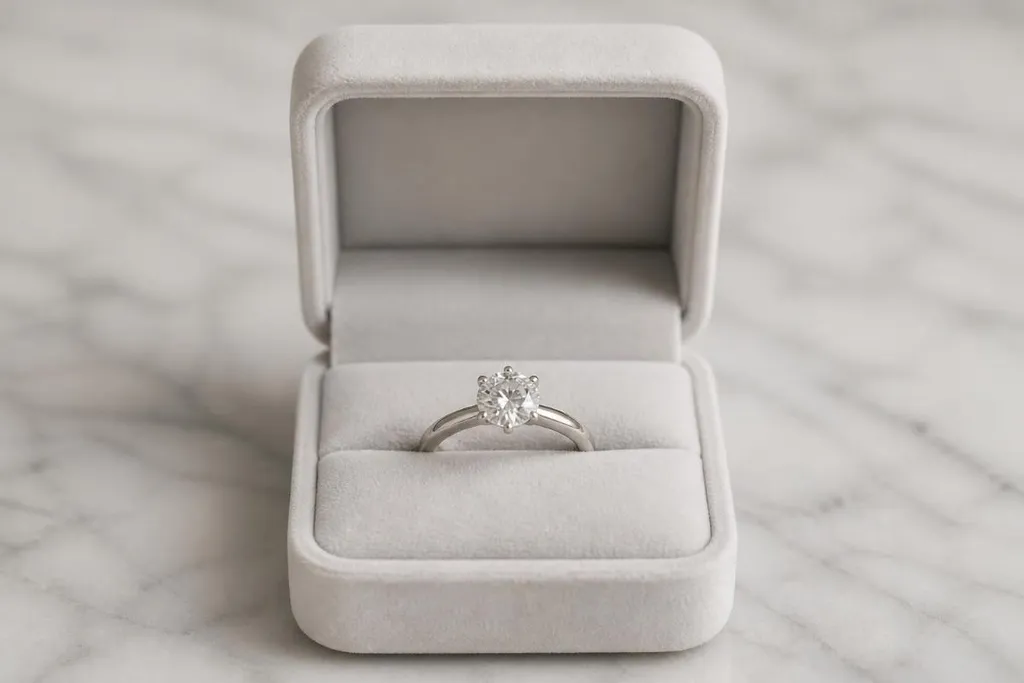
Jewellery trends continually introduce new settings, unusual silhouettes and increasingly intricate details, yet the solitaire engagement ring remains remarkably resistant to fashion cycles. Its appeal comes from restraint: one diamond, carefully proportioned, with little competing for attention.
That simplicity is particularly effective with lab-grown diamonds. Rather than relying on decorative elements to create impact, a solitaire allows the centre stone's shape, proportions and brilliance to define the ring. Exploring beautiful lab diamond solitaire rings reveals how much variation can exist within this seemingly simple format. Differences in diamond shape, carat weight, band profile, metal and setting height can give each solitaire a distinct personality while preserving its characteristic elegance.
Simplicity Places the Diamond at the Centre
A solitaire succeeds because there is nowhere for the design to hide. Without a halo or multiple side stones, attention naturally falls on the centre diamond and the craftsmanship surrounding it.
This makes proportion especially important. A delicate band can emphasise the scale of the diamond, while a slightly broader band may create a more substantial, architectural appearance. The number and arrangement of claws also influence the result. Four-claw settings can expose more of the stone, whereas six claws often create a traditional silhouette and an additional sense of security.
The simplicity also makes a solitaire exceptionally adaptable. A restrained design can complement understated everyday jewellery while still carrying enough presence for formal occasions. Years later, it is unlikely to look tied to one particular jewellery trend.
Diamond Shape Changes the Character Completely
Although round brilliant diamonds are strongly associated with classic solitaire rings, they are only one interpretation of the style.
An oval lab-grown diamond creates an elongated, graceful appearance and often offers generous visual coverage across the finger. Pear-shaped stones introduce asymmetry and a more individual character, while emerald cuts replace intense brilliance with crisp lines and broad flashes of light. Radiant and cushion cuts can provide a softer outline without sacrificing noticeable sparkle.
Shape also affects perceived size. Two diamonds with identical carat weights may look quite different once set because their dimensions and depth distribute weight differently. An elongated 2-carat oval, for instance, may appeal not simply because it is larger than a 1-carat option, but because its proportions create the finger coverage and visual balance the wearer prefers.
The right choice is therefore less about selecting the most impressive number and more about finding a shape that suits both hand and personal style.
The Setting Should Work With Everyday Life
Solitaire rings may look uncomplicated, but their setting details deserve careful thought.
A higher setting can create an elegant side profile and make the diamond appear particularly prominent. It may also allow certain wedding bands to sit more closely alongside the engagement ring. For someone who frequently wears gloves, handles equipment or works extensively with their hands, however, a lower-profile setting may prove more practical.
Metal contributes another layer of character. Platinum and white gold offer a cool-toned appearance that blends naturally with the brightness of a diamond. Yellow gold introduces warmer contrast, while rose gold can soften the overall look.
These choices do not alter the fundamental simplicity of a solitaire. Instead, they allow the design to be adapted around the person who will actually wear it.
Why Solitaires Offer Long-Term Versatility
One advantage of a solitaire is that it leaves room for future styling decisions. Because the engagement ring itself is visually clean, it can work with anything from a simple polished wedding band to a diamond-set design.
It also lends itself naturally to ring stacking over time. Anniversary or eternity bands can introduce additional texture and sparkle without making the original engagement ring feel overly complicated.
This versatility matters because an engagement ring is not chosen for a single outfit or occasion. It needs to coexist with changing tastes, jewellery collections and lifestyles over many years.
Final Thought
The lab diamond solitaire remains timeless because its design depends on proportion and restraint rather than ornamentation for ornament's sake. A carefully chosen diamond, thoughtfully set on a well-balanced band, needs surprisingly little else.
Its apparent simplicity also gives the wearer meaningful choices from diamond shape and scale to metal and setting profile. The result can feel traditional, contemporary or distinctly individual while retaining the quiet elegance that has kept the solitaire relevant for generations.